A year ago, Eid al-Adha — a cardinal celebration in both the imagination and calendar of the Kingdom — was, for the first time in decades, effectively called upon not to take place. Not canceled in the liturgical sense, of course, but suspended in its sacrificial dimension out of concern for preserving the national livestock herd, exhausted after seven consecutive years of drought. The gesture, restrained in form yet profound in meaning, said everything that needed to be said. When the soil cracks, when grazing lands empty out, when breeders are forced to sell off their herds for lack of fodder, no tradition, however deeply rooted, remains immune to reality.
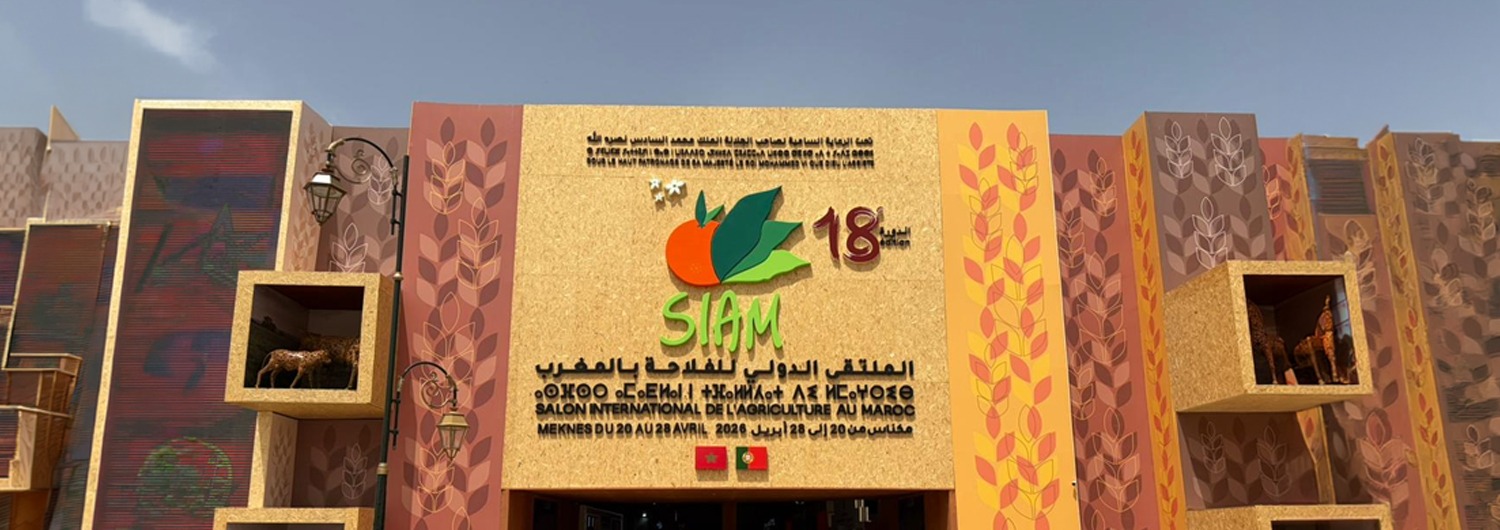
One year later, the Salon International de l’Agriculture au Maroc 2026 opened in Meknes from April 20 to 28 and chose, precisely, to place animal production at the heart of its eighteenth edition. The symbolism is far from accidental. Placing livestock at the center of the national agricultural narrative, in the same year that the sacrificial ritual regains its place under finally generous rainfall, is to publicly acknowledge that what happened last year was not an isolated episode, but a warning.
And indeed, it rained — heavily. Sometimes even excessively, as evidenced by the floods that struck the country’s northwest and forced large-scale evacuations. Yet none of that diminishes the relief. Alhamdulillah, reservoirs are filling again, pastures are turning green, fodder crops are regrowing, and the livestock sector is mechanically breathing once more. Feed prices, long hostage to global markets and imported oilseed meal, are easing their grip. Breeders are slowly rebuilding their herds. Households are finding slightly more breathing room in meat prices. Objectively speaking, the economic climate is gentler than it has been in years.
But as is often the case, periods of relief are precisely when one must beware of false conclusions. A good rainy season does not constitute an agricultural policy, just as one swallow does not make a spring. And confusing a cyclical rebound with an escape from structural crisis would be the worst possible interpretation of what the country has just endured.
By linking the sustainability of animal production with food sovereignty, this 2026 edition openly acknowledges what the past seven years have etched into public consciousness: Morocco’s dependence on imported inputs — whether raw materials for animal feed, seeds, fertilizers, or the energy required to produce them — has become a major strategic vulnerability. And that vulnerability is no longer merely economic; it is geopolitical.
This is where the reasoning takes on another dimension. In the world now emerging before our eyes, food sovereignty no longer exists as an isolated concept. It has become the reverse side of the same coin whose other face is energy sovereignty. Producing food means producing the energy that powers tractors, pumps irrigation water, manufactures fertilizers, keeps cold chains running, and transports harvests. Disconnecting these two dimensions is a luxury that only large integrated powers can still afford — and even they, increasingly, cannot.
The choice of Portugal as guest of honor for this edition is therefore less anecdotal than it might appear. Beyond the diplomacy of exhibition pavilions, Rabat and Lisbon share a common agro-climatic reality: chronic water stress, rainfall variability, and the necessity of adapting productive models to climate disruption. What the two countries can exchange are not political postures but tested methods — precision irrigation, cooperative pooling, agro-industrial valorization, and sophisticated water-resource management. Whereas Spain and France, honored in previous editions, primarily brought scale, Portugal brings proximity of constraint, which paradoxically may sometimes be more valuable than grand lessons from the North.
Because a country’s food sovereignty is first and foremost written in its soil. And in 2026, soil can no longer be nourished randomly. The needs of farmland in Meknes are not those of Senegalese or Indian soil, and pretending they could all be treated with the same recipe was a dead end the global economy could tolerate only when energy and agricultural inputs were cheap. That world is now behind us. Agronomic precision, which may sound highly technical, is in reality almost a matter of common sense. It enshrines the idea that every hectare matters, every drop of water matters, every gram of input matters. In a country emerging from seven years of drought while projecting itself toward the ambitious horizon of 2030, this culture of precision becomes a vector of success.
Especially since the livestock equation — the very issue structuring SIAM 2026 — is one of relentless logic. The quality of animal feed depends on the quality of fodder. The quality of fodder depends on soil fertility. Soil fertility depends on precision in nutrient application and water availability. And water, the energy required to mobilize it, the fertilizers needed to enrich the soil, and the industrial capacities necessary to produce those fertilizers locally all form a single chain, none of whose links can any longer be outsourced remotely without exposing the entire system to systemic risk.
Last year’s suspension of the sacrifice ritual was, whether one likes it or not, the brutal revelation of this equation. Not because there were no animals left to slaughter, but because there was no longer enough to feed them properly and sustainably. And no one wishes to relive that reality — neither breeders, nor households, nor the authorities who had to make the difficult decision to suspend a millennia-old rite.
In that respect, the Salon International de l’Agriculture au Maroc 2026 is far more than a trade fair; it is an annual exercise in collective truth. It measures the distance between stated intentions and actual trajectories. It reveals the country’s capacity to coordinate its sectors, institutions, foundations, researchers, cooperatives, and farmers around a shared vision. And this year more than any other, it will measure Morocco’s maturity in not confusing calm with stability.
Because soil, like sovereignty, never regenerates as quickly as it deteriorates. And between a good season and a sustainable trajectory lies precisely the difference between luck and strategy.
Zouhair Yata