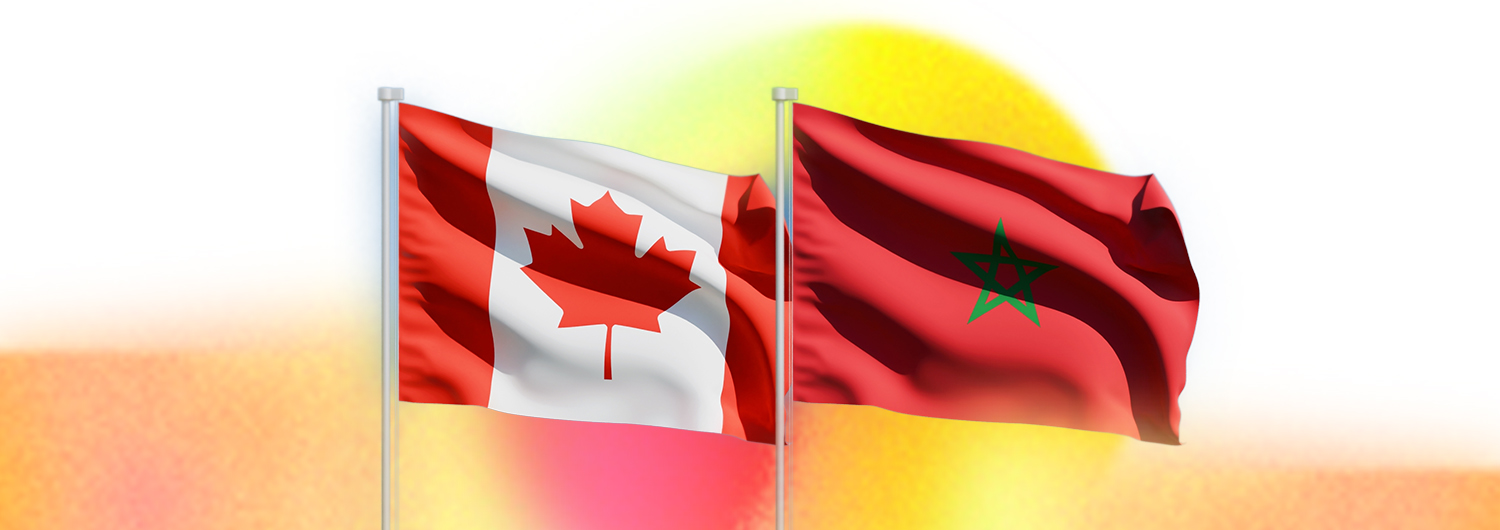
Who said that the international context risked slowing Morocco’s momentum toward the full recognition of its sovereignty over the Sahara? Moroccan diplomacy has once again defied predictions by securing another major victory, this time in Ottawa.
On April 28, 2026, Canadian Foreign Minister Anita Anand officially announced, following talks with her counterpart Nasser Bourita, her country’s new position recognizing Morocco’s autonomy plan as the “basis for a mutually acceptable solution,” while drawing the appropriate conclusions from UN Security Council Resolution 2797 adopted on October 31, 2025. An official visit by Canada’s top diplomat to Morocco has been announced for the coming weeks, and Canada thus joins the now substantial circle of states that have clarified their position on a matter that has shaped Moroccan diplomacy for half a century.
Ottawa is not just any capital in this equation. Canada hosts one of the world’s most dynamic Moroccan communities, particularly concentrated in Montreal and active in strategic sectors such as healthcare, higher education, technology, and services. For years, this diaspora has served both as a cultural bridge and, paradoxically, as one of the points of friction in bilateral relations, in a country where certain voices hostile to the Kingdom had become accustomed to thriving beneath the comfortable umbrella of a sometimes poorly understood multiculturalism. Canada’s gesture therefore goes beyond diplomacy alone; it also restores coherence for hundreds of thousands of Moroccans in Canada between their dual identity and the official position of their host country.
In reality, this recognition is part of a broader dynamic that began long before last October. European, African, and Latin American support for the autonomy plan has steadily accumulated in recent years, but Resolution 2797 marked the true turning point by consecrating autonomy under Moroccan sovereignty as the sole basis for negotiation. Since then, the momentum has moved in only one direction: the United Kingdom, Austria, Switzerland, Ecuador, and now Canada, not to mention Honduras’s withdrawal of recognition for the so-called “SADR.” Each time, the calendar seems to produce another diplomatic adjustment, as though chancelleries that once hesitated now understand they have more to lose from ambiguity than from clarity.
And while this patient diplomacy advances step by step, the security dimension follows the same trajectory, with the same method. On April 27, Agadir hosted the official launch of African Lion 2026, the largest military exercise conducted on the African continent. More than 5,000 soldiers from around forty countries were deployed across Benguerir, Tan-Tan, Taroudant, Dakhla, and Tifnit, while the maneuvers expanded to include Ghana, Senegal, and Tunisia. The 2026 edition stands out for its technological leap forward, integrating rapidly evolving domains such as electromagnetic warfare, cyberspace, outer space, and unmanned aerial systems.
But the detail that deserves particular attention lies elsewhere. For the first time on the African continent, the Royal Moroccan Armed Forces were integrated into the secure tactical communication system Link-16, previously reserved for NATO members. This is not a technical footnote for specialists. It is the military translation of what Resolution 2797 represented diplomatically: Morocco is now perceived and treated as a first-rank strategic partner, on par with the closest allies of the Western bloc. When the Pentagon shares a communications channel, it is never insignificant, and it says more than any long speech about the depth of the alliance.
All of this can only irritate neighboring Algeria, which hardly views Morocco’s diplomatic advances favorably, as every Moroccan step forward represents a step backward for Algiers. Yet one must resist any triumphalist reading, because Algeria is itself experiencing a paradoxical geopolitical moment. The war in Iran and the resulting instability in global energy markets have restored a strategic centrality to Algerian gas that it had temporarily lost, placing Algiers once again in the role of key supplier for a Europe seeking energy security. Added to this is a frequently underestimated geopolitical reality: Algeria has long been a historical partner of Tehran, and the absence of a decisive strategic defeat for the Islamic Republic, despite the blows it has suffered, reinforces an axis that will continue to shape future regional balances.
This is precisely why Morocco must avoid the temptation of bravado. The doctrine adopted by Rabat — strategic restraint on the ground combined with patient firmness diplomatically — is exactly what has produced tangible results sequence after sequence. Canadian recognition, integration into Link-16, and the continuous expansion of international support have not materialized by chance. They are the product of a long-term vision, assumed at the highest level of the state and executed with rare discipline in an era that often values noise more than results.
Ultimately, what this sequence of events in April 2026 reveals is that a country can continue to build, consolidate alliances, and expand its sphere of influence even while the world around it burns between Tehran, Tel Aviv, and Washington. Morocco is moving forward — calmly but steadily — with the understanding that consistency over time always prevails over grandstanding.
Zouhair Yata